
Montgomery County Supervision Types
Parole and probation can both place a person in the community under rules, but they begin in different ways. The Tennessee Department of Correction types of release page defines parole as community release authorized by the Tennessee Board of Parole before a sentence expires. TDOC then supervises the parolee. A grant is only one stage. Pre-parole conditions and approval of a release plan can remain unfinished, so a Board action does not prove a physical departure.
Probation is imposed by a court. It may replace imprisonment or follow jail time as part of a split sentence. TDOC states that a person placed on probation, including one released from split confinement, must report promptly to the assigned probation and parole officer. Montgomery County also has local supervision programs outside the TDOC felony route. The judgment and case level help identify which office holds the record.
| Status | How it begins | Montgomery County verification route |
|---|---|---|
| Parole | Board-authorized release before sentence expiration | FOIL status, Board record, and TDOC District 80 |
| Felony probation | State-court community sentence or split sentence | FOIL, judgment, and TDOC District 80 |
| Misdemeanor probation | General Sessions court order | County court record and Montgomery County Adult Probation |
| Community Corrections | Community-based alternative for an eligible felony case | Court order and the county Community Corrections office |
A county jail release and a state status must still be kept apart. Someone can leave Montgomery County Jail for TDOC custody and remain incarcerated. Someone marked parole or probation in FOIL may be outside prison but still under supervision.
- Parole
- Conditional community release before a prison sentence expires.
- Probation
- A court-ordered community sentence, sometimes following a period in jail.
- Discharge
- The formal end of a custody or supervision obligation shown by the responsible agency.
- Absconder
- A formal supervision status that must come from an agency record, not a missed call or old address.
Verify Montgomery County Post-Release Supervision
The public starting point for a Tennessee felony case is TDOC Felony Offender Information Lookup, or FOIL. Its status can read incarcerated, probation, parole, or inactive. The system may also show a location, offense and sentence details, release information, or parole-hearing status. FOIL does not cover every misdemeanor, diversion, federal supervision term, or out-of-state order. It also does not prove the precise time that Montgomery County Jail completed a local discharge.
- Search FOIL by name, TDOC or TOMIS ID, or Tennessee SID. Use the ID when available to avoid a same-name match.
- Read the current status and any release information together. Do not turn a future Release Eligibility Date into a completed release.
- Check the Montgomery County court case when the sentence type or ordering court is unclear. The judgment can distinguish probation, split confinement, and other dispositions.
- Route state felony supervision to TDOC District 80. Route a General Sessions misdemeanor order to County Adult Probation.
- For historical proof, ask TDOC Records Management or the responsible local office for the public discharge or supervision record.
The Montgomery County released inmate search and records path explains how to confirm the separate jail exit when the question begins with a county booking.
Note: Record the date of every status check because supervision, revocation, custody, and inactive status can change.
Montgomery County Supervision Offices
The local office depends on the order, not just the place where a person lives. The official TDOC Field Office Directory places Montgomery County in District 80, a multi-county state district. That office is the local route for Tennessee felony probation and parole. Its directory does not promise public access to an assigned officer's name, a reporting plan, treatment information, or private location details.
TDOC Community Supervision, District 80
100 Providence Boulevard, Suite A
Clarksville, TN 37042
Phone: 931-648-5550
Fax: 931-648-5565
Ask whether District 80 is the correct public contact for the specific state status and what record or identifier is needed. A current status question is different from a request for a formal discharge instrument. TDOC Records Management is the better channel when an exact historic end date matters.
Local Montgomery County Supervision Paths
Montgomery County has two local programs that should not be blended with TDOC state supervision. Montgomery County Adult Probation supervises misdemeanor probation orders from General Sessions. Its Clarksville office is at 121 South Third Street, and its listed numbers are 931-648-2240 and 931-245-3196. A misdemeanor probationer may never appear as a TDOC felony offender, so an empty FOIL result is not the end of the check.
Montgomery County Community Corrections is a separate community-based sentencing alternative for eligible felony offenders. The published number is 931-648-5776. Participation is grounded in the court order and program record. It is not a release database, and it does not supply the physical discharge time from the Montgomery County Jail.
This local split is a distinctive part of Montgomery County post-release supervision. Start with the judgment. If it names local Adult Probation, use that office. If it places the person under TDOC, use FOIL and District 80. If it names Community Corrections, follow that county program instead of assuming ordinary probation.
The official Montgomery County Adult Probation page shows the local office and its role.
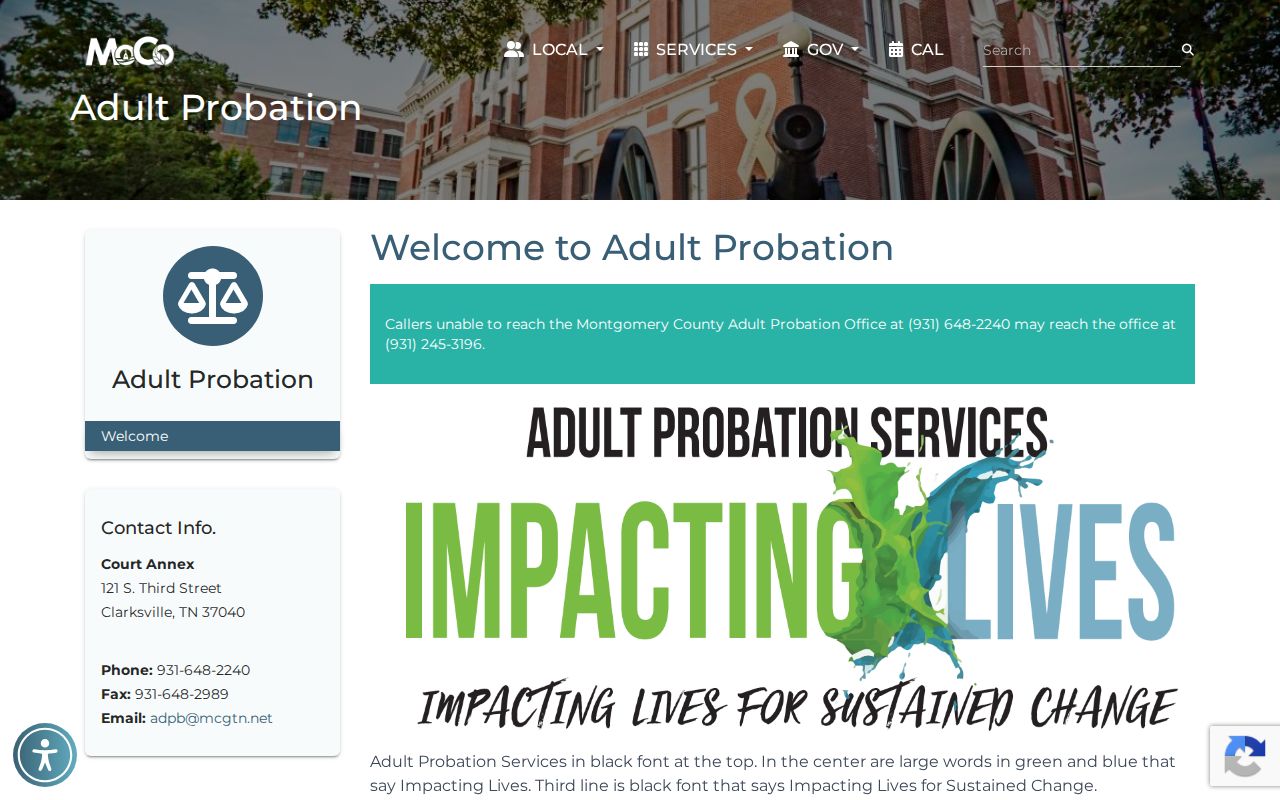
The captured page is useful for routing a General Sessions misdemeanor case, while a state felony status remains a TDOC matter.
Note: A community program can confirm its own supervision role but cannot certify a separate jail release event.
Montgomery County Warrants After Release
A possible warrant can change the risk of renewed custody, but it does not prove that a person violated supervision or absconded. MCSO maintains an official name-based warrant search. The Sheriff's Office requires further confirmation through its Warrants Division at 931-648-0611. A same-name result needs identity checks before it is tied to a Montgomery County release.
No official public TDOC absconder list specific to Montgomery County was found. Do not infer absconder status from silence, an old address, or failure to reach an office. Look for an official TDOC status, an active warrant, a revocation filing, or a Board proceeding. Each source answers a different question: the sheriff confirms its warrant, the court shows filed action, and TDOC confirms its supervision record.
The MCSO warrant interface illustrates why a public result is only a lead.
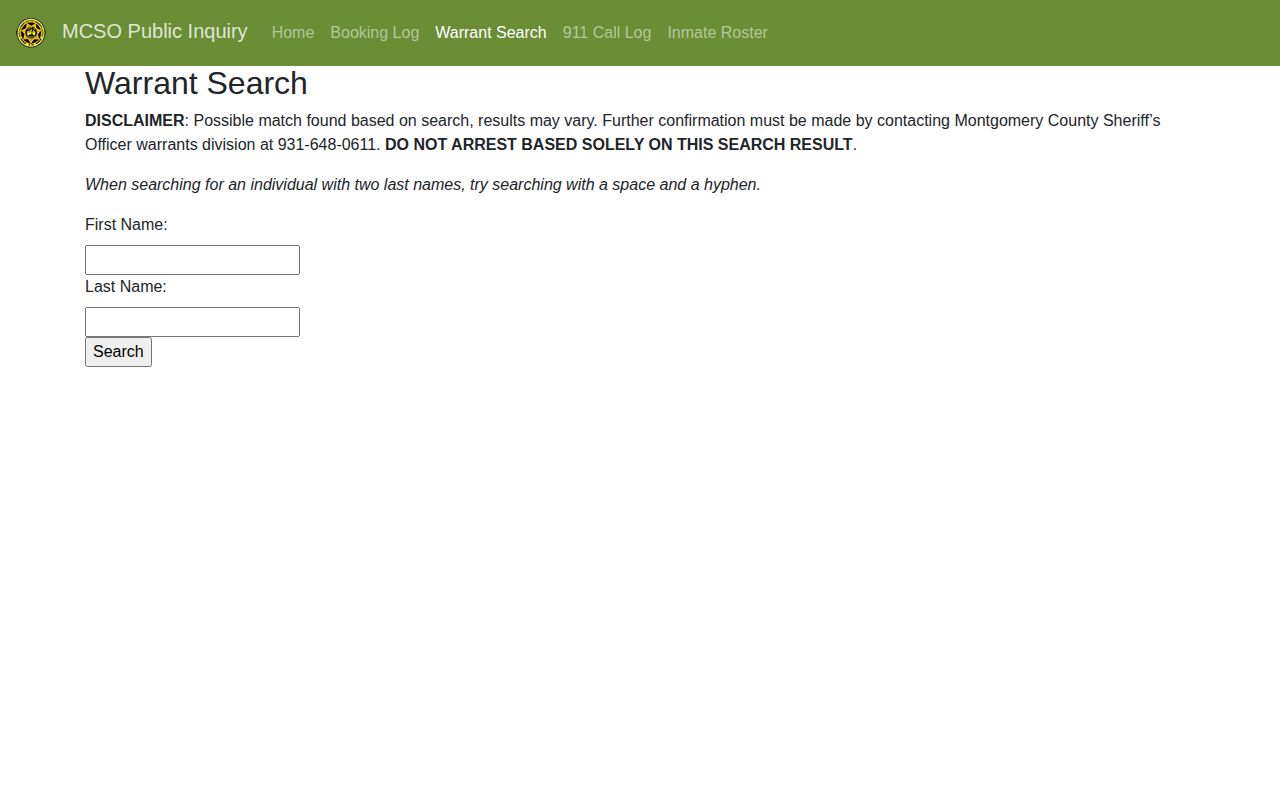
Its name search should be followed by the confirmation line and the relevant court or supervision record.
Montgomery County Parole Hearing Records
The Tennessee Board of Parole decides parole, while TDOC maintains sentence data and supervises people after release. The Board's Parole Hearing Schedules page says schedules are updated weekly and are now requested by email. Last-minute changes can occur. A schedule only shows that a hearing is planned; it is not a decision page and does not establish release.
At a hearing, an officer makes findings and a nonbinding recommendation. Board members may adopt, change, or reject it. Grant, revocation, rescission, custodial, and time-setting proceedings have distinct meanings. A custodial parole action can move a person from one sentence to another without community release. A grant can still depend on an approved release plan.
No verified stand-alone public Board decisions database was found. After a hearing, check FOIL for updated hearing and custody status, then contact the Board when the result is unclear. Its central number is 615-741-1150. A formal parole status or release record is stronger proof than a calendar entry.
The Board's current schedule page shows the official request route.
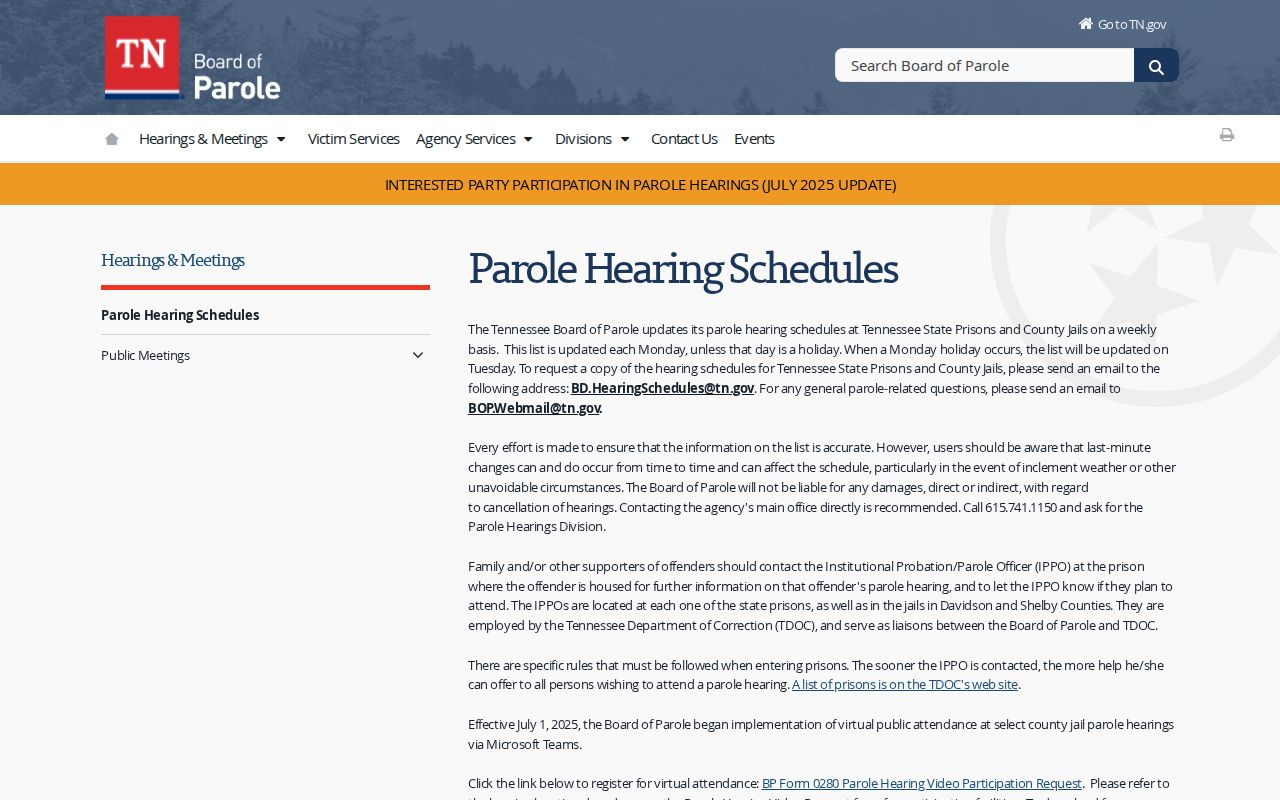
This schedule source helps trace a pending proceeding, but FOIL and the final agency record must confirm what happened next.
Note: A hearing recommendation, scheduled date, or parole grant is not the same as completed physical release.
Montgomery County Release Conditions
Supervision conditions come from the Board, court, release plan, and governing law. Public records may show the status and broad basis, but private reporting details should not be published. A person on parole can face a preliminary revocation hearing, a final revocation hearing, reinstatement, or revocation. A pre-parole rescission can stop a planned release before it occurs.
Tennessee also recognizes determinate release, mandatory reentry supervision, and Community Supervision for Life for qualifying cases. These terms do not apply to every Montgomery County person. Mandatory reentry supervision under the framework TDOC describes can cover the last part of an eligible felony sentence, subject to custody, detainer, charge, and disciplinary limits. Community Supervision for Life starts after the ordinary prison, probation, or parole term for offenses covered by state law.
VINE can provide a prospective custody alert for a participating offender, but it is not an absconder or supervision database. A change alert should be matched to FOIL, the Board, or the releasing agency. A transfer or revocation event must not be rewritten as an unconditional community release.
Ending Montgomery County Post-Release Supervision
Supervision ends through the authority responsible for it. An inactive FOIL status can support that TDOC no longer reports active custody or supervision, but it should be checked against release information and the underlying record. A county misdemeanor probation term ends under the local court order and Adult Probation record. Community Corrections has its own order and program path.
When the exact date or type matters, request the discharge instrument or sentence-status record. Identify the person by full name and offender number when known, name the record sought, and give the approximate supervision period. Ask the custodian for existing records rather than asking it to calculate a new legal conclusion.
A completed discharge does not rewrite the prior custody record. It identifies the point when the named supervision obligation ended. Other cases, registries, or jurisdictions may still exist, so match the statement to the agency and sentence shown in the record.